
The intelligent platformbehind hospitality.
How GuestAI delivers a white-label guest app, an AI-powered operations console and a canonical integration layer — without a hotel ever surrendering its brand, its data or its margins.
- Audience
- Hoteliers & operators
- Region
- UK / eu-west
- First module
- Weddings
- Pilot
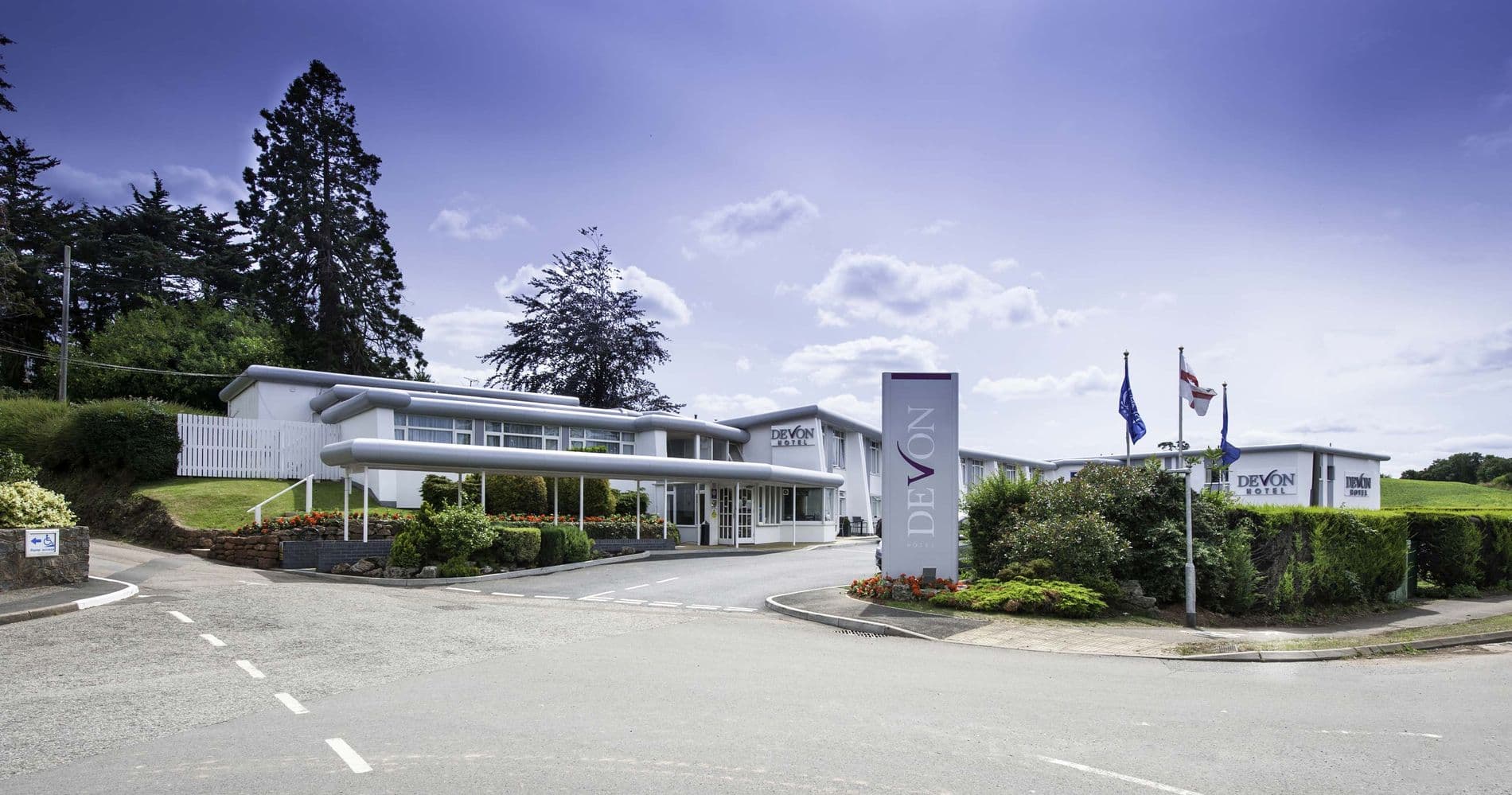
- The Devon Hotel
Executive summary
GuestAI is a multi-tenant, white-label platform that gives hotels and event venues the guest technology of a global chain — delivered entirely under their own brand. It combines a branded guest application, an AI-powered operations console, a conversational concierge and a deterministic automation engine on a single shared backend, integrated with the property's existing management system through one canonical data model.
The platform is engineered around a simple conviction: technology should deepen the relationship between a venue and its guests, never stand between them. Guests experience only the hotel's name and identity; the GuestAI brand lives solely on the staff-facing console. The first module is Weddings, with corporate, celebration of life, celebrations, festive and group travel built into the architecture from day one and enabled per tenant.
Most of what the industry markets as “AI” is really workflow. GuestAI reserves the language model for the concierge — where judgement helps — and runs everything else as fast, predictable, auditable automation.
The problem
Independent hotels and venues run complex events on tools never designed for them: shared inboxes, spreadsheets, paper function sheets and the memory of a single coordinator. A wedding can generate dozens of email threads across the couple, guests, suppliers and six internal departments. Critical details — final numbers, a severe allergy, a deposit deadline — live in fragments, and the cost of a dropped detail is measured in ruined events and lost revenue.
At the same time, guests increasingly expect the frictionless, self-service, always-on experience the large chains and OTAs have trained them to want. Few independents can build that themselves, and the platforms that offer it typically do so under their own brand, capturing the guest relationship and the resulting data.
- Operational risk: details scattered across systems and people
- Revenue leak: upsells, upgrades and unsold room blocks missed
- Brand erosion: third-party apps capturing the guest relationship
- Lost intelligence: every event's data evaporating after the day
The platform
GuestAI is one backend powering two surfaces. The guest applicationis a white-label progressive web app carrying only the hotel's name, logo and colours, on the hotel's own domain; guests join by passwordless magic link and get a concierge, event schedule, RSVP, dietary capture, room booking and a digital wallet. The operations consoleis the venue's command centre — a single live event dashboard with a readiness health score, dietary and kitchen reporting, supplier compliance, revenue intelligence and granular role-based access.
Branding is configuration, not code. A single tenant configuration record drives identity, the modules that are switched on, the AI's authorisation policy and the PMS connection — so a new venue goes live in days, and native iOS/Android apps can be produced from the same codebase as a premium tier under the hotel's own store accounts.
GuestAI is the platform hotels buy. The guest-facing apps carry only the hotel's brand. “Powered by GuestAI” is optional, per tenant.
Architecture & data model
Every surface and integration speaks GuestAI's own canonical model — events, guests, rooms, reservations, dietary requirements, suppliers, tasks, payments, consent and an append-only change log. PMS-specific fields never leak above the adapter layer, which means adding a new property management system is a matter of writing one adapter against a fixed interface, not re-architecting the product.
The platform is multi-tenant from the first row. Every tenant-owned record carries a tenant identifier, and PostgreSQL row-level security enforces isolation at the database itself — a backstop that holds even if application code has a bug. Tenant context is always derived server-side from the authenticated token, never from a client-supplied value. A tenant that demands physical isolation can be moved to a dedicated database without code changes, because all access already flows through the tenant-scoped data layer.
The integration layer is live first on Guestline Rezlynx, with Mews, Apaleo and Oracle OPERA implementing the same interface. Rezlynx remains authoritative for rooms, reservations, rates and folios; GuestAI is authoritative for event-planning data — RSVPs, dietary, seating, timelines, tasks and suppliers. Writes are idempotent and every material change is reconciled and logged.
The AI concierge
The concierge is a retrieval-augmented, tool-using assistant served entirely server-side. Static knowledge — FAQs, packages, policies, directions — is retrieved from a vector store and grounded in the hotel's own content. Live facts — room status, balances, ceremony times — are never invented; they are fetched in real time through typed tools that query the canonical model and the PMS.
Crucially, the assistant's ability to act is governed by a policy engine, not by prompt instructions. Every tool — submit an RSVP, log a dietary need, request an upgrade, create a booking — is set per hotel to one of three states:
- auto — the assistant executes directly (e.g. answer an FAQ, capture a dietary need)
- confirm-first — the assistant prepares the action; staff approve it in the console
- disabled — the tool is never offered
Because this is enforced in the tool-execution layer, a jailbreak cannot bypass it: the model proposes, the policy disposes. Platform guardrails are non-overridable — no medical, legal or financial advice; no fabricated availability or prices; automatic human handoff on low confidence or sensitive topics — and every action and the input that triggered it is written to the audit log.
The automation engine
Behind every module is an event-driven automation engine. Domain services emit events; the engine evaluates rules and produces tasks, notifications, documents and integration actions; time-based rules enforce deadlines. This is deterministic by design — fast, predictable and auditable — which is exactly what operations demand.
Grounded in The Devon Hotel's real terms, the engine enforces the workflow a venue actually runs: a £1,000 non-refundable deposit secures and provisionally blocks a wedding date; final numbers and balance fall due four weeks out, with escalating reminders to the couple and tasks to the manager while the health score drops; room blocks are released on schedule with guest nudges; and any severe allergy raises an immediate kitchen alert that also lands on the auto-generated function sheet.
Deadlines, routing, function sheets and kitchen reports running as rules — not as a coordinator's to-do list — is what removes operational risk and gives back hours every week.
Guest intelligence & revenue
Because every event runs on the platform, every event also enriches it. GuestAI captures attendance, spend, dietary needs and preferences, booking and lead-time patterns, communication engagement and lifecycle dates — cleanly, in one place, per guest and per venue. That is the difference between a tool that runs an event and an intelligence layer that makes the next one smarter.
Data becomes venue insight, and insight becomes revenue, in a simple loop — guest data → venue insight → revenue action. The extra revenue is concrete:
- Accommodation — smarter room-block management and timely upgrade offers lift occupancy and ADR
- Food & beverage — pre-orders, drinks packages and breakfast add-ons, sold before arrival
- Upgrades & add-ons — late checkout, upgrades, spa and parking surfaced at the right moment
- Repeat events — anniversaries, birthdays, festive and corporate rebooking become a pipeline
At the same time, the platform removes hours of repetitive work every week. The concierge answers repeat questions instantly; function sheets, briefings and kitchen reports generate themselves; guests self-serve their own dietary needs and details; and post-event follow-up runs automatically. Coordinators spend their week on guests, not on retyping and chasing.
Unlike a generic PMS or CRM, GuestAI builds a long-term, consented guest profile for each hotel that deepens with every event — a marketing engine and a proprietary data asset the venue owns outright.
The intelligence roadmap
Because the concierge, automation layer and live data already exist, the highest-value additions arrive as features rather than rebuilds. The near-term roadmap prioritises capabilities that move revenue and reputation:
Self check-in follows the same principle of incremental value: mobile pre-check-in in the existing guest app first, and a lobby-tablet kiosk later — gated on two-way PMS write-back, key-encoder and payment integration, which are the genuinely heavy dependencies. Predictive models (staffing, return probability, lifetime value) are architected now by capturing the data; the models are trained once that data exists.
Event modules
Every module sits on the shared platform and is enabled per hotel. Guest profiles, automations and intelligence carry across all of them, so a venue can start with one and grow into the rest without migration.
Security, privacy & compliance
Each hotel is the data controller; GuestAI is the processor, operating under a data processing agreement with named sub-processors. Data is encrypted in transit and at rest, hosted in-region for UK residency, and protected by least-privilege access, secrets management and full audit logging.
Privacy is treated as load-bearing architecture, not an afterthought. Dietary and allergy information is special-category health data: minimised, access-restricted to the roles that need it, and excluded from marketing by default. The bereavement (celebration of life) module carries heightened sensitivity, with restricted access and no marketing automation. A single consent record is the gate for every guest communication — no campaign runs without a valid, unexpired lawful basis — and right to erasure cascades across the canonical store, vector store and sub-processors.
Commercial model
GuestAI is priced per venue: a base subscription per property covers the platform, guest app and console, with each event module priced and enabled independently. Native apps are a premium add-on, and variable-cost items — AI usage, SMS, payment volume — are metered transparently. A venue pays only for the events it runs and can scale up as it adds modules and properties.
The model aligns with the product's promise: the hotel keeps its brand, its guest relationship and its data as a compounding asset, while GuestAI provides the engine and absorbs the complexity.
Pilot & delivery
GuestAI is being built hand-in-hand with The Devon Hotel in Exeter — a working venue running weddings, corporate days, celebrations and more on Guestline Rezlynx. Grounding the product in one real operation keeps it honest: if a feature does not make a real wedding run more smoothly, it does not ship.
Delivery is phased — multi-tenant foundations and identity, then the weddings MVP with the branded app, concierge and core automations, then two-way PMS write-back, payments and native apps, and finally the remaining modules and the marketing engine. The Guestline integration — webhook availability, write-back coverage and certification — is treated as the critical path and de-risked first.
Conclusion
GuestAI gives independent hotels and venues a genuinely modern guest experience and a calmer, more profitable operation — without the trade-off that usually comes with it. One intelligent platform runs the event and engages the guest; the hotel keeps the brand, the relationship and the data.
We are partnering with a small number of forward-thinking venues for the first phase. If that is you, we would love to talk.
See the platform on your venue.
A 30-minute walkthrough of the guest app and the operations console, mapped to your real events and your PMS.